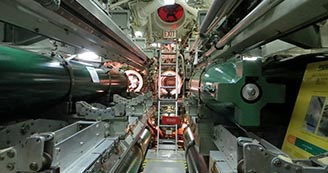
To design the equipment and systems to safely transfer torpedoes from shore based transport to the torpedo bay storage locations on the British Navy's new fleet of nuclear submarines. As distinct from previous designs, the new designs were to withstand shocks due to nuclear depth charges which could be used against the submarine during warfare. This new Admiralty requirement imposed severe new constraints on the design of the torpedo lift and the storage bays.
In contrast to previous designs the focus of the new design was to use advanced analytical techniques to ensure that the design developed would remain operative after being subjected to the severe energy absorption scenarios induced by nuclear depth charges. Much of the design was supported by significant energy calculations derived using both hand calculations and finite element methods.
Many of the 'experienced' engineers were unfamiliar with these new design requirements nor how to approach them. However, by the application of the new calculation methodologies coupled with physical tests at locations in the north of Scotland a design was established which the team where confident would pass Admiralty tests.
As a young engineer on this project I was assigned as a Lead Design Engineer and I was tasked with leading the design of the mechanical and hydraulic systems in the design. This role was interesting in that I had to also 'lead' the more senior engineers into areas they were unfamiliar with and, at times, were not comfortable with (the resulting designs often looked 'too beefy' for them!). However, I was successful in education the 'seasoned' team through the new Admiralty specifications and my designs were accepted by the team for submission to prototype manufacture and test. Unfortunately, I left to follow other opportunities before the design was finally put into production and, due to the 'Official Secrets Act' in the UK, I was never able to find out what further modifications were needed to my designs before entering service.