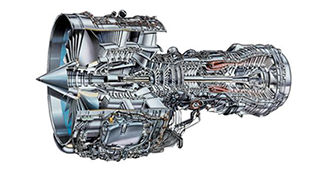
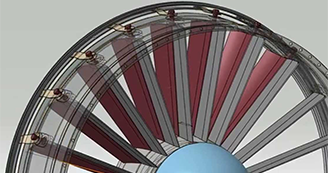
During the development of the V2500 Engine Rolls Royce developed a variable stator blade mechanism to improve the power profile of the engine under various load conditions. In order to develop this system they needed to study, in details, the characteristics of the stator blade actuation travel against the stator blade angle of attack so that they could program the actuator to deliver the right stator blade angle for a given engine load.
Rolls Royce had detailed 3D models of the Stator Blade mechanism but is was taking several weeks to establish the actuator travel vs stator blade angle during each design iteration which was imposing unacceptable delays on the design lead time
A demonstration was made to Rolls Royce on how they could use their CAD models in the context of an ADAMS analysis to directly generate the actuator/stator blade characteristics,
Rolls Royce were able to reduce the lead time from 4 weeks to 30 minutes for each design iteration significantly reducing the design cycle time, improving quality and significantly reduce
the design costs associated with this activity
I was responsible for identifying the solution to the issues faced by Rolls Royce, developing the demonstrator, presenting the findings. Subsequently I was responsible for training a group of 5 Rolls Royce engineers in the use of these techniques and maintaining engagement with them to ensure their success on later studies.