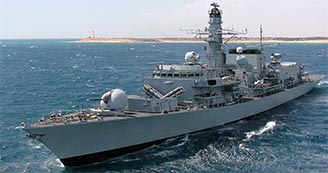
A foreign navy had ordered a frigate to be built by a British shipbuilding company. The weapons systems the foreign navy had specified included a Goalkeeper Gatling Gun which fired spent Uranium bullets to be used as an anti missile defense system. The challenge this presented was that the target acquisition system for the gun was at the top of the mast on the superstructure. During firing the gun was exciting frequencies in the ship structure and causing significant deflections of the mast in respect to the gun which was causing inaccuracies in the guns aim.
A complete Finite Element model of the ship was developed using the CAD geometry as a foundation. The model was then analyzed to determine the natural frequencies of the ship structure form which modifications could be identified to alleviate or minimize the effect of the gun firing frequencies which were causing resonance in the ship structure.
Using the integrated Finite Element modelling within the CAD system it was possible to develop a detailed Finite Element model of the ship structure in less than three weeks which was fully representative of both the ship structure and the mass distribution of ancilliary items such as non structural mass representing the weapons systems and other significant sources of mass such as the anchor chains. Other techniques used by a UK university had taken more than a year and had only focused on the bridge portion of the ship.
The results obtained enabled the engineers to identify the major areas of the structure which were contributing to the 'phase shift' between the Goalkeeper weapons system and the target acquisition radar, make necessary modifications to the structure and significantly improve the performance of the Goalkeeper targeting system.
I was responsible for developing the Finite Element model of the Frigate and, with the guidance of the ship engineers, model all the significant non structural mass elements. I was also responsible to executing the analysis and for advising the customer where the major issues were in the structure.