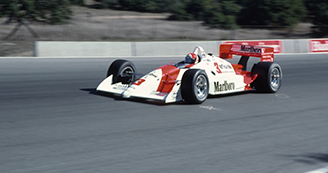
Team Penske used to design their Indy Open Wheel racers in the UK. They develop very high power vehicles and one of the problems they experienced early in their design of the CART race car was over torque of the gearbox at the start of the race. This resulted in the 'twisting' of the gearbox when the driver released the clutch on the grid which led to one rear wheel 'lifting' from the track and resulting in uneven traction from the rear wheels and an unstable start from the grid. Design changes would be needed to stiffen the gearbox to minimize this torsion effect, However, in order to determine the most efficient way to add additional material to the gearbox, which would add unwanted weight to the design, the behavior of the gearbox under loading conditions needed to be clearly understood.
Finite Element models were developed, in conjunction with the Penske engineering team and analyses performed.
Using the Penske CAD data, the Finite Element models were developed rapidly and analyzed using NASTRAN.
From
these it was clear where the gearbox needed to be stiffened and it was also possible to reduce material usage and hence reduce the weight of the gearbox.
Using these techniques the Penske team were able to, very rapidly, gain an insight into their design and make necessary changes to alleviate the grid torsion issues they were having in the design.
I was the Lead Consultant on this activity leading the Penske engineers in the use of the techniques in conjunction with their CAD tools and educating them for future development activities on the design.. During this time Emerson Fittipaldi was racing for the team in the CART series.