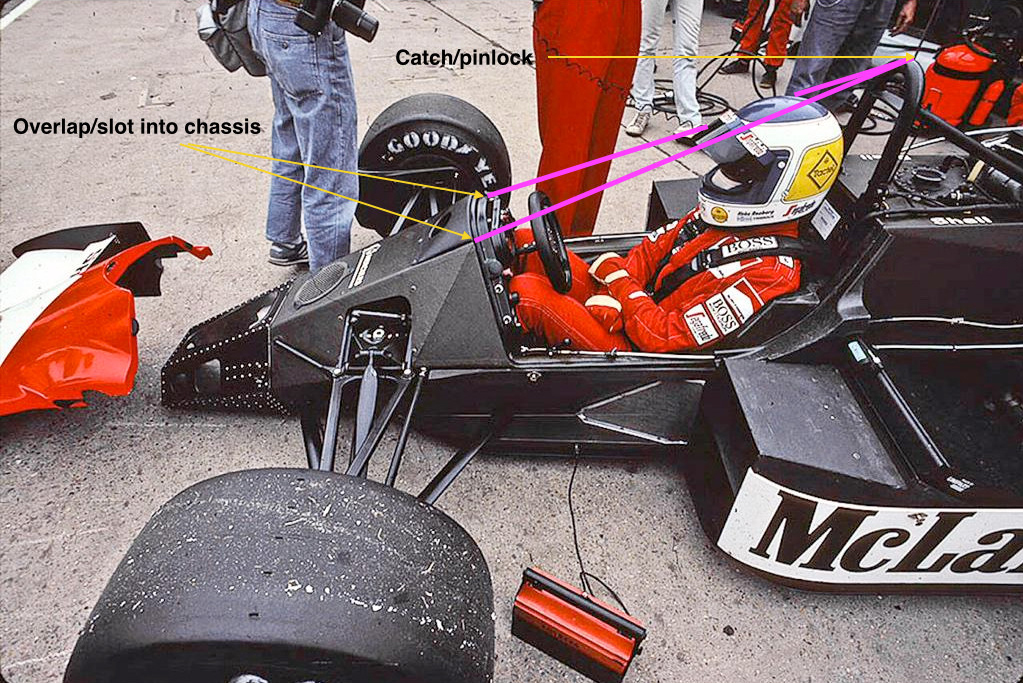
In the early 1990's the FIA introduced regulations regarding the integrity of roll over hoops, survival cells and safety harnesses. At the time McLaren driver team was Gerhardt Berger and Ayrton Senna. This was a transformative time for Formula One and the safety of the cars, and of the whole sport, began to improve rapidly. As part of that it was a requirement that the Formula 1 car must be able to land, inverted, on the race track without the drive safety cell being compromised in any way. This placed very rigorous demands on the integrity of the roll hoop which needed to be determined both experimentally and using analytical techniques.
Finite Element methods were used to analyze the behavior of the role hoop under various configurations using the ANSYS analysis tools. Initial models were developed, analyzed and compared with results obtained experiementally to determine the integrity of the analytical models. Many further configurations were then analyzed to ensure the overall integrity of various design options.
Using the Finite Element method, it was possible to analyze many different roll over conditions and many different design options to ensure that the FIA regulations could be met on the final design when tested physically without having to physically test all the different variations.
I worked closely with McLaren engineers to develop the necessary Finite Element models directly from their CAD geometries, training them in the use of both the techniques and the interpretation of the results. During that time I also got to eat lunch with and talk with Ayrton Senna in the McLaren canteen!