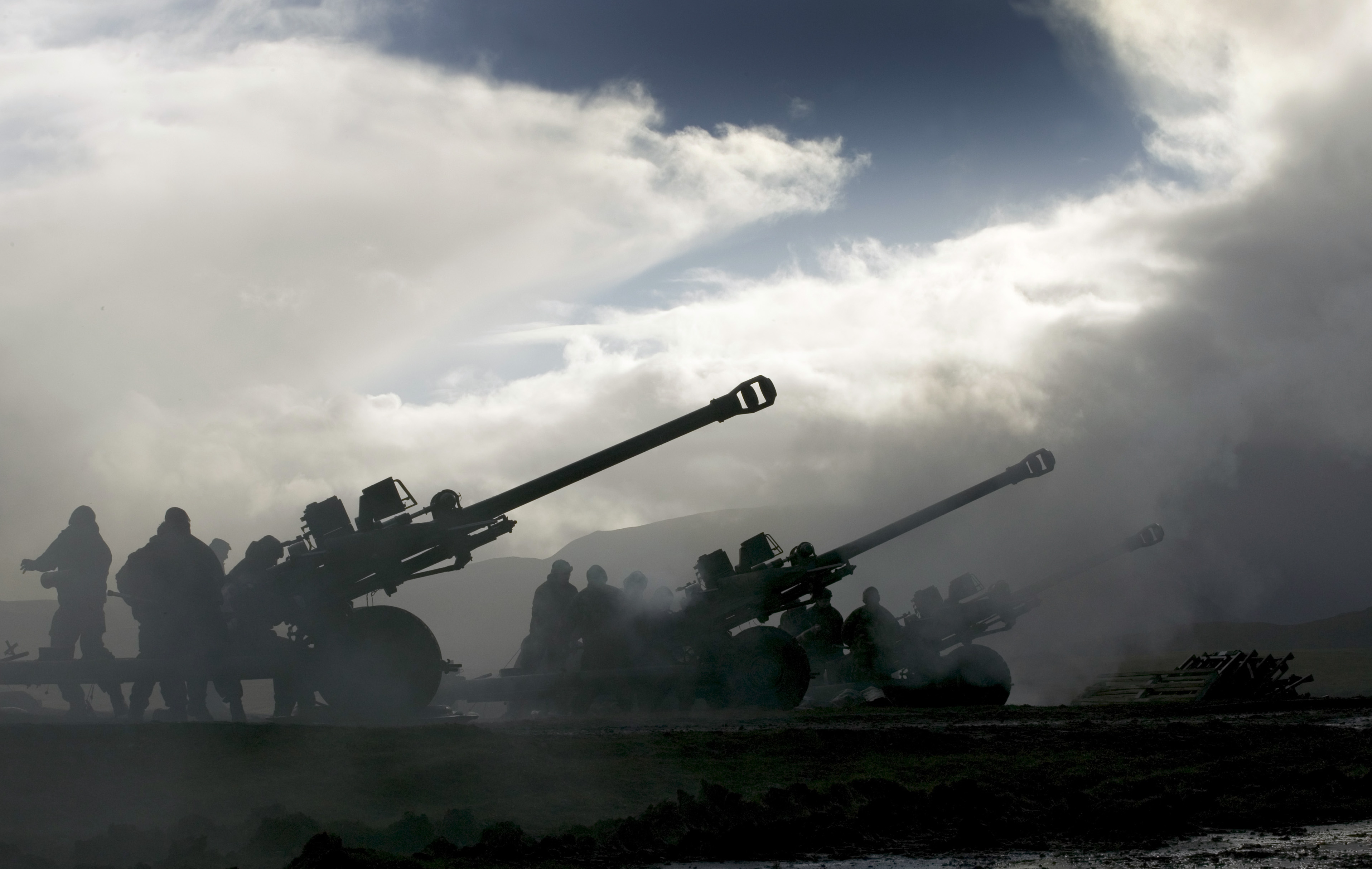
The L105 Light Gun was developed in the UK for use, initially, by the British Army. However, the popularity of the design has resulted in its export throughout the world for use by foreign armies. There are several variants of the gun using many different propellant charges depending on the range required. A version of this gun was ordered by the Swiss Army who required a particularly powerful propellant to significantly increase the range of the gun.
The issue with this requirement was that the integrity of the muzzle brake at the front of the barrel could not be assured during firing due to the increase in gas pressure associated with the more powerful propellant. A full understanding of the loads on the muzzle brake needed to be determined. However, any attempts to determine these loads experimentally (by placing pressure transducers on the muzzle brake) resulted in the destruction of the instrumentation during the firing and no useful data could be derived. It was necessary to approach this issue analytically.
A gas dynamics analysis was performed using the PISCES Finite Difference analysis code after modelling the scenario using Lagrangian and Eulerian grids to model the barrel/muzzle structure, projectile and the gas domain inside and around the gun. Several analyses were undertaken, and the models tuned to match the pressure space curves which had been derived from experimental results using lower power propellants. Analysis was then undertaken to simulate the higher power propellant to determine the potential loading on the muzzle brake.
The results obtained enabled RARDE (Royal Armaments Research and Development Establishment) to anticipate the full loading experienced during the firing with the high power
propellant and make necessary design changes to ensure the integrity of the muzzle brake. This enabled the Swiss Army to meet their range requirements with the 105mm Light Gun which is now in service in Switzerland.
I was the lead consultant for this activity, engaging in the initial negotiations, executing the analysis, presenting the results and making design recommendations to RARDE (the customer). I also used this engagement as the basis of my thesis to the Institute of Mechanical Engineers in the UK which led to the award of the titles "Chartered Engineer" and "Member of the Institute of Mechanical Engineers".